

Choosing between a general dentist and an oral surgeon for wisdom teeth removal in Attleboro depends on the complexity of your case. General dentists handle simple, fully erupted teeth, while oral surgeons manage impacted or complex cases. At Perfect Dental, we provide clear guidance to help you select the right provider for your specific anatomical needs and comfort level.
Understanding the Role of a General Dentist
A general dentist is a licensed dental professional trained to provide comprehensive oral care, including preventive services, restorative treatments, and basic surgical procedures. In the context of wisdom teeth, a general dentist is often the first point of contact. They perform routine exams and take X-rays to evaluate the position of your third molars. If the teeth are fully erupted and have sufficient space, a general dentist can typically perform the extraction in their office.
Strengths of General Dentists
General dentists offer convenience and continuity of care. You likely already have a relationship with your general dentist, who understands your dental history and overall oral health. For simple extractions, this familiarity can make the process smoother and less stressful. Additionally, general dentists can manage post-operative care and monitor healing during your regular checkups, ensuring that the extraction site integrates well with the rest of your mouth.
Limits and Suitability
The primary limitation for a general dentist is the complexity of the case. If your wisdom teeth are impacted, meaning they are stuck in the jawbone or tilted against other teeth, the procedure requires specialized surgical skills. General dentists may refer these cases to an oral surgeon. This option suits patients with straightforward, non-impacted wisdom teeth who prefer to keep all their dental care under one roof.
The Role of an Oral Surgeon
An oral surgeon is a dental specialist who has completed additional years of advanced training in oral and maxillofacial surgery. This specialized education equips them to handle complex surgical procedures, including the removal of deeply impacted wisdom teeth, bone grafting, and jaw corrections. Oral surgeons are trained to manage the anatomical complexities of the jaw, such as proximity to nerves and the angle of tooth eruption.
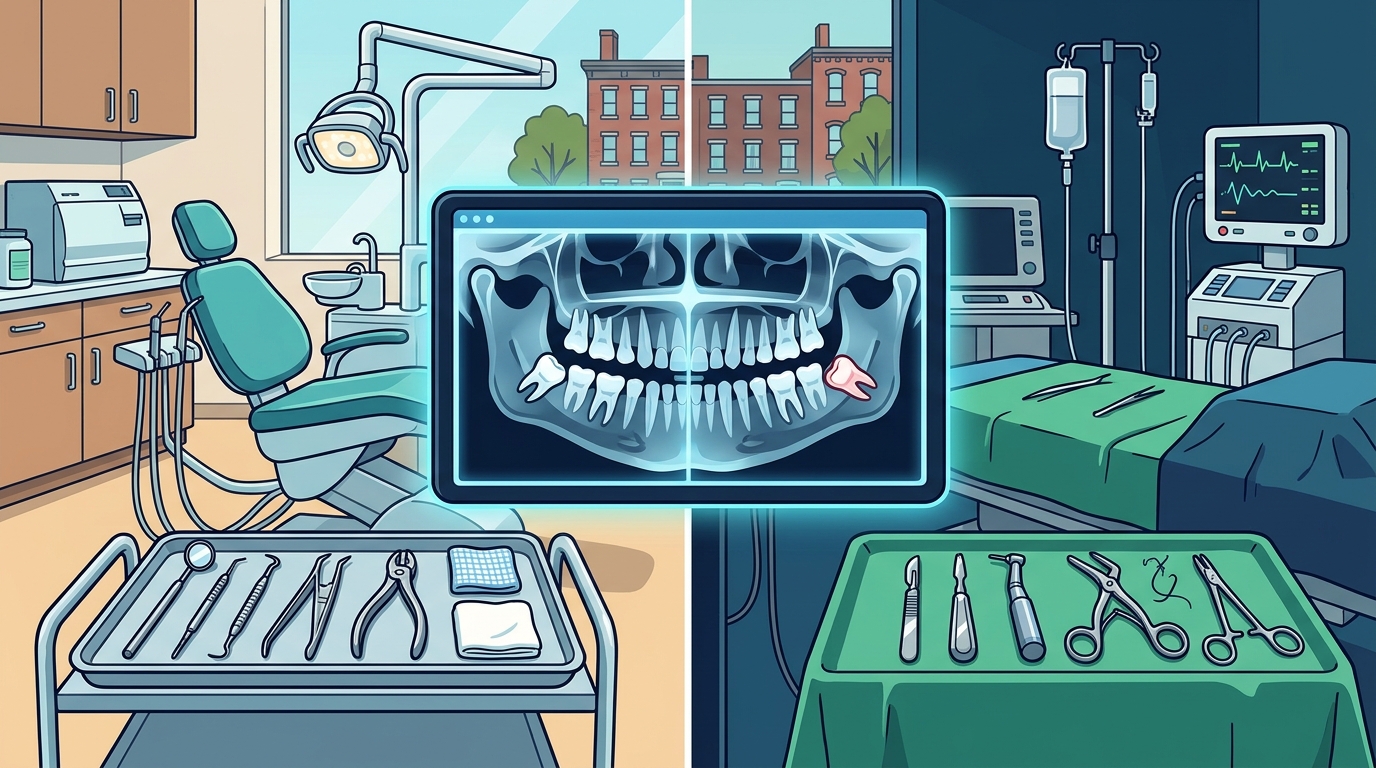
Strengths of Oral Surgeons
Oral surgeons bring specialized expertise to complex cases. They are equipped with advanced surgical tools and techniques designed to minimize trauma to surrounding tissues. For patients with impacted wisdom teeth, an oral surgeon can safely remove the tooth while protecting nearby structures. Their training also includes managing potential complications, such as nerve damage or infection, which are more common in complex extractions.
Limits and Suitability
While oral surgeons are highly skilled, they may not be the first choice for simple, routine cleanings or basic fillings. Their focus is on surgical interventions. This option suits patients with impacted, tilted, or partially erupted wisdom teeth, or those who have a history of difficult extractions. If your X-rays show that the roots of your wisdom teeth are curved or close to the inferior alveolar nerve, an oral surgeon is the recommended provider.
Comparison of Provider Options
| Criteria | General Dentist | Oral Surgeon |
|---|---|---|
| Training Focus | Comprehensive dental care and basic surgery | Advanced oral and maxillofacial surgery |
| Case Complexity | Simple, fully erupted teeth | Impacted, tilted, or complex cases |
| Continuity of Care | High, often your primary provider | Specialized, focused on surgical intervention |
| Post-Op Monitoring | Integrated into regular checkups | Specific surgical follow-ups |
| Referral Process | May refer out for complex cases | Referred by general dentists for surgery |
Choosing the Right Provider for Your Needs
Selecting the right provider requires an honest assessment of your specific dental situation. The decision is not about one provider being better than the other, but about matching your case to the appropriate level of expertise.
Choose a General Dentist If
You should choose a general dentist if your wisdom teeth are fully erupted and have adequate space in your jaw. This is also the right choice if you prefer to maintain a single point of contact for all your dental needs. General dentists at Perfect Dental can evaluate your X-rays and determine if a simple extraction is feasible. If you have no history of complications and your teeth are straight, a general dentist is often the most convenient and efficient option.
Choose an Oral Surgeon If
You should choose an oral surgeon if your wisdom teeth are impacted, tilted, or partially erupted. This is also the recommended path if you have a history of anxiety or difficult dental experiences, as oral surgeons are trained to manage complex surgical environments. If your X-rays show that the roots are close to nerves or if the teeth are fused to the bone, an oral surgeon provides the specialized skills needed for a safe and effective procedure.
Frequently Asked Questions
Can a general dentist remove impacted wisdom teeth?
Generally, no. While some general dentists may perform simple extractions of partially erupted teeth, deeply impacted wisdom teeth usually require the specialized training of an oral surgeon. The complexity of the surgery, including the need to remove bone or section the tooth, typically exceeds the scope of general dental practice. A general dentist will usually refer you to an oral surgeon for these cases.
What is the cost difference between a general dentist and an oral surgeon?
Costs vary based on the complexity of the case. Simple extractions by a general dentist are often less expensive than complex surgical extractions by an oral surgeon. However, insurance coverage may differ depending on the provider and the specific procedure. It is important to obtain a detailed estimate from both providers to understand your out-of-pocket costs. Perfect Dental can help you review your insurance benefits before treatment begins.
Do I need to see an oral surgeon if my wisdom teeth are not hurting?
Not necessarily. If your wisdom teeth are fully erupted and healthy, they may not need to be removed at all. However, if they are impacted or causing crowding, removal is often recommended to prevent future issues, even if they are not currently painful. A general dentist can evaluate your X-rays to determine if removal is necessary and refer you to an oral surgeon if the case is complex.
How do I know if my case is complex enough for an oral surgeon?
The best way to know is through a professional evaluation. Your general dentist will take X-rays to assess the position of your wisdom teeth. If the teeth are tilted, fused to the bone, or close to nerves, the case is considered complex. In these situations, a referral to an oral surgeon is the standard of care to ensure safety and effectiveness.
Can I switch providers if my general dentist refers me to an oral surgeon?
Yes, you can choose to seek a second opinion from another general dentist or oral surgeon. However, it is important to follow the recommendation of your primary provider, as they have the most complete understanding of your dental history. If you are referred to an oral surgeon, it is usually because the case requires specialized surgical skills that are outside the scope of general dentistry.
Next Steps for Your Wisdom Teeth
Deciding between a general dentist and an oral surgeon is a critical step in managing your oral health. By understanding the specific roles of each provider, you can make an informed decision that aligns with your needs. At Perfect Dental, our team is committed to providing clear guidance and personalized care. We can evaluate your X-rays, discuss your options, and connect you with the right provider for your specific case. To schedule a consultation or to learn more about our services, contact our team. Learn more: Contact Us Perfect Dental.